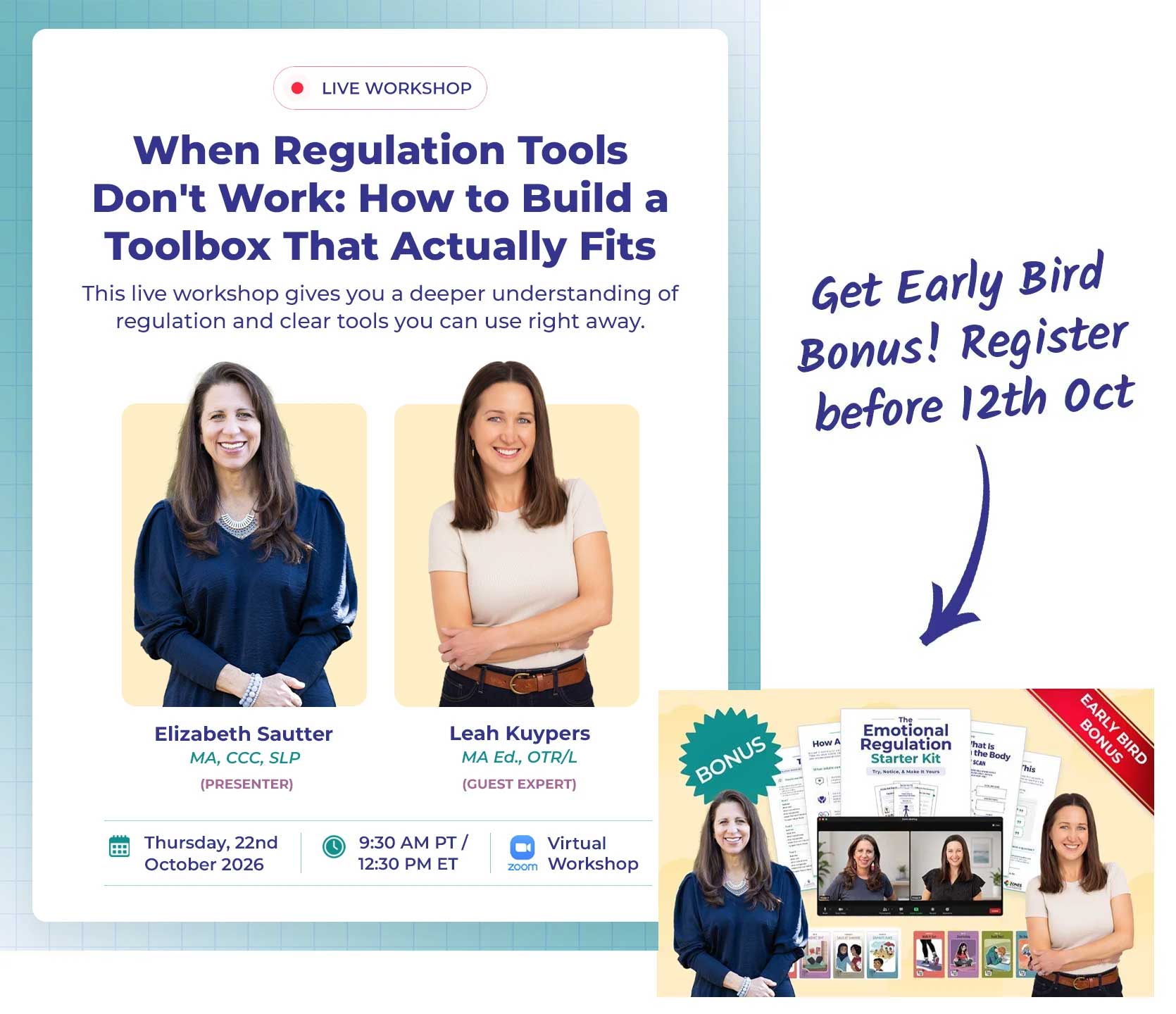
Practical tools. Mindset shifts. Lasting impact.
Elizabeth Sautter is a nationally recognized social-emotional learning expert, speech-language pathologist, author, and mother of two neurodivergent sons. With over 25 years of experience supporting families, educators, and therapists, Elizabeth delivers heartfelt, accessible presentations that leave audiences feeling seen, empowered, and equipped.
Whether she’s speaking to a room full of parents or guiding a school team through SEL strategies, Elizabeth makes social-emotional development feel doable—and even joyful.
Elizabeth Sautter has been featured in:











Speaking Topics Include:
Redefining Listening: Supporting Engagement, Regulation, and Connection
Move beyond “whole-body listening” and explore listening as an internal process supported by regulation, emotional safety, and connection.
Learn more
Ideal for: 1–3 hour presentation or full-day workshop
This session reframes listening beyond observable behaviors and compliance. Participants will learn how listening is shaped by nervous system readiness, emotional safety, motivation, and meaningful engagement.
Participants will explore the history and evolution of Whole Body Listening, including updates informed by neurodivergent perspectives, and learn practical strategies that support authentic listening, participation, and connection across learning and social environments.
Participants will learn to:
- Describe genuine listening beyond visible behaviors
- Understand the evolution of Whole Body Listening
- Explain how regulation supports listening and learning
- Apply neurodiversity-affirming strategies for engagement and connection
10 Brain-Based Strategies to Make Social and Emotional Learning Stick
Learn practical, brain-based ways to embed social and emotional learning into everyday routines, real-life moments, and meaningful interactions.
Learn more
Ideal for: 1.5 hour training to full-day workshop
Social and emotional learning is most effective when it is simple, consistent, and connected to real life. This session offers 10 practical strategies that support regulation, flexible thinking, emotional awareness, and everyday skill-building.
Participants will learn how to weave supports into daily routines and interactions so skills can generalize across home, school, therapy, and community settings.
Participants will learn to:
- Describe how brain-based strategies support development
- Embed supports into everyday routines and activities
- Apply tools that promote regulation and flexible thinking
- Support skill generalization across settings
The Social Toolbox: Problem Solving and Regulation Strategies for Meaningful Connections
Support social development through practical tools for regulation, perspective taking, flexible thinking, problem solving, and confident decision-making.
Learn more
Ideal for: 1.5–3 hour training or full-day workshop
Navigating social situations is complex and deeply connected to regulation, executive functioning, language processing, sensory needs, and emotional safety. This training reframes social support through a strengths-based, neurodiversity-affirming lens.
Participants will explore how regulation supports situational awareness, social understanding, flexible thinking, and connection. Practical tools will be shared to make abstract social expectations more concrete, accessible, and useful across developmental levels and settings.
Participants will learn to:
- Describe how regulation supports meaningful connection
- Shift from surface-level behaviors to connection and autonomy
- Understand how executive functioning, language, and sensory processing affect social understanding
- Apply tools for problem solving, flexibility, and safe decision-making
Nurturing Neurodiversity for Belonging and Inclusion
Explore how to create more inclusive, affirming environments that support dignity, autonomy, flexibility, and meaningful participation.
Learn more
Ideal for: 1–3 hour training
This session supports educators, therapists, and support professionals in shifting from deficit-based and compliance-focused practices toward strengths-based, neurodiversity-affirming approaches.
Participants will reflect on the process of unlearning long-held assumptions, including the discomfort and grief that can come with change. Elizabeth shares her own professional evolution and offers practical strategies to support belonging, inclusion, and environments that honor differences.
Participants will learn to:
- Describe the shift from deficit-based to affirming practices
- Reflect on current practices and opportunities for growth
- Understand the emotional process of unlearning
- Apply strategies that promote belonging, autonomy, and participation
- Create environments that support inclusive engagement
Essential Executive Functioning: Routines, Regulation, and Readiness
Learn practical strategies to support routines, task initiation, time awareness, flexibility, follow-through, and growing independence.
Learn more
Ideal for: 1.5–3 hour training
Executive functioning affects how learners start, sustain, and complete tasks throughout the day. This session focuses on real-life strategies that support routines, organization, time awareness, flexibility, and follow-through.
Participants will explore how regulation and readiness influence executive functioning and learn how to embed practical supports into everyday routines across settings.
Participants will learn to:
- Describe key components of executive functioning
- Explain how regulation and readiness impact task initiation and completion
- Identify factors that support or interfere with executive functioning
- Apply strategies for organization, flexibility, and follow-through
10 Ways to Support Kids and Teens with Anxiety and Stress
Learn practical, brain-based strategies to help kids and teens feel safer, more supported, and more confident across daily routines.
Learn more
Ideal for: 1.5–3 hour training
Anxiety and stress can impact learning, participation, behavior, and overall well-being. This session helps participants recognize signs of overwhelm and respond with supportive tools, language, and co-regulation strategies.
The focus is on practical, everyday supports that reduce stress, build connection, and help kids and teens access coping tools across environments.
Participants will learn to:
- Describe how anxiety and stress impact learning and participation
- Identify signs of overwhelm across learners and environments
- Apply brain-based strategies that support regulation and connection
- Use supportive language and co-regulation tools to build confidence
Make Social Regulation Stick: Tools to Support Coping, Confidence, and Connection
Explore regulation as the foundation for learning, relationships, mental health, coping, confidence, and meaningful engagement.
Learn more
Ideal for: 2–3 hour training
This session explores regulation as an interconnected system that includes sensory, emotional, and executive functioning. Participants will move beyond behavior-focused approaches and learn how co-regulation, emotional safety, and mindset shifts support resilience, autonomy, and connection.
Practical, brain-based strategies and real-world examples will help participants immediately apply tools that support coping, confidence, and meaningful engagement.
Participants will learn to:
- Describe how regulation supports learning and social engagement
- Understand the shift from behavior management to co-regulation and connection
- Explain how neurodiversity-affirming practices support autonomy and resilience
- Apply practical strategies that support coping, confidence, and connection
Boosting Social Communication and Situational Awareness
Help kids build a stronger understanding of themselves, others, and their environments so they can navigate social situations with more ease and cultivate meaningful connections at home, in school, and in the community.
Cultivating Meaningful Connections: Supporting Neurodivergent Kids in Building Authentic Relationships
Learn how to nurture connection through emotional awareness, regulation, perspective-taking, and interest-based social engagement. This session also includes strategies for building self-advocacy skills and creating supportive environments that honor each child’s unique way of relating to others.

Don’t See What You’re Looking For?
If you don’t see a topic that fits your needs, reach out! I offer additional presentations on related themes and have a team of trusted professionals who can speak on a wide range of topics—all grounded in neurodiversity-affirming practices.
Together, we can find the right fit to support your audience with a focus on emotional regulation, executive functioning, and social connection.
Who Elizabeth Serves

Nonprofits, family service agencies & community orgs

Therapists, clinicians & support teams

Preschool–12th grade educators & administrators

Parent groups & caregivers
Testimonials

This training completely shifted my understanding of listening. Elizabeth helped me see that regulation, not stillness, is the key to real engagement.
– Michael T.
Engaging, compassionate, and clear—Elizabeth made the Zones feel accessible and relatable. I walked away with strategies I could apply that same day.
– Lindsey W.
Elizabeth is incredibly passionate and knowledgeable. Her tips for building SEL into daily routines were practical, research-based, and best of all—manageable for real-life parenting!
– Daniela S.
Speaking Formats
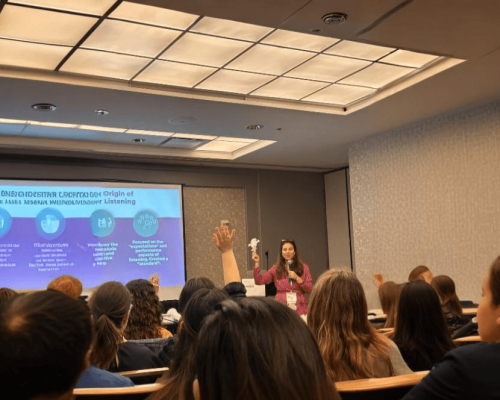
Elizabeth offers presentations in-person or virtually, including:
- Keynotes
- Parent education nights
- School district professional development
- Therapist/clinician trainings
- Guest webinars & summits
All sessions include practical strategies, evidence-based tools, and an optional Q&A to personalize the experience.
Ready to Bring Elizabeth to Your Event?
Whether you’re hosting a small parent group or a large district-wide training, Elizabeth will work with you to tailor the presentation to your audience.